Introduction
Most of the clients who come into Julia Lundstrom’s programs are not starting from zero.
They’ve already tried to improve their health—adjusting their diet, increasing activity, and following structured routines. For many, the issue isn’t effort. It’s a lack of clarity around what is actually driving their symptoms.
At Simple Smart Science, Julia’s model is built around that gap. Her work focuses on helping clients understand how their body responds to food, stress, sleep, and daily habits in a way that is practical and repeatable. Rather than relying on generalized recommendations, her approach is centered on making those responses visible.
Over time, she began integrating continuous glucose monitoring (CGM) into her programs—not as the foundation of care, but as a way to shorten the feedback loop between behavior and outcome. Julia’s approach and the use of CGM are intended for individuals seeking to improve both metabolic and cognitive health outcomes.
For providers exploring CGM, her model highlights how real-time glucose data can be used to improve both metabolic health and cognitive performance without adding unnecessary complexity to the care process.
Key Takeaways:
- Julia stages CGM deliberately — clients spend several weeks building consistent habits before a device is introduced, so the data adds clarity rather than noise
- The brain-metabolic connection is central to her model: when glucose patterns stabilise, clients report improvements in energy, focus, and sleep alongside physical changes
- CGM makes invisible patterns visible — stress, sleep disruption, and meal timing all show up in the data in ways that client-reported symptoms alone can’t capture
- Coaching shifts from directing behaviour to interpreting patterns — clients begin anticipating their own responses and making adjustments independently
- Theia handles onboarding, device logistics, and troubleshooting end-to-end, allowing Julia’s team to stay focused on coaching rather than operational issues
Julia’s Practice Model and Patient Population
Julia’s work sits at the intersection of metabolic health, brain performance, and behavior change.
Her patient population includes individuals dealing with:
- persistent fatigue
- brain fog
- inconsistent energy
- disrupted sleep patterns
- early metabolic dysfunction
A consistent pattern across this group is that symptoms are often disconnected from traditional lab results. Patients may fall within “normal” ranges while still experiencing significant day-to-day variability in how they feel and function.
Her model is designed to address that gap by focusing on:
- metabolic stability
- nervous system regulation
- sustainable behavior change
- long-term performance optimization
At the core of this approach is a simple principle:
“Your brain is the cockpit for your whole body. When you improve brain function, everything else starts to follow.”
This framework shifts care away from isolated symptom management and toward understanding how different systems interact over time.
What Led Julia to Explore CGM
Before integrating CGM, most of the feedback Julia relied on came from patient-reported symptoms.
Energy levels, focus, cravings, and sleep patterns provided useful signals, but they were often inconsistent or difficult to interpret at scale. Two patients could follow similar recommendations and report very different outcomes.
From a provider standpoint, this creates a familiar problem. Adjustments are being made based on patterns, but without visibility into what is happening in real time, there is always some degree of uncertainty.
That uncertainty tends to show up on the patient side as well. When progress slows, patients often assume they are doing something wrong—even when they are not.
Introducing CGM changed that dynamic.
“The instant feedback changes everything. It takes something abstract and makes it real.”
By using CGM systems to monitor glucose levels continuously, Julia was able to observe patterns that were previously invisible—particularly how stress, sleep, and daily routines influenced metabolic responses. CGM provides continuous, actionable glucose data that supports more informed wellness decisions, replacing guesswork with real-time insights. Additionally, CGMs can reduce or eliminate the need for fingerstick capillary glucose testing, offering a practical advantage for both patients and providers.
Understanding CGM Systems in Practice
As Julia began incorporating CGM into her model, it also required a shift in how both providers and patients understood the technology itself.
Continuous glucose monitoring (CGM) systems have transformed how providers approach metabolic health, offering a level of insight that traditional blood glucose meters cannot provide. Unlike intermittent testing, CGM devices—such as those from Dexcom and Abbott Diabetes Care—deliver real-time glucose readings throughout the day and night, capturing trends, variability, and responses to food, exercise, stress, and medication.
Modern CGM systems use a small sensor placed just under the skin, which continuously measures glucose levels in the interstitial fluid. These sensors transmit data wirelessly to a receiver, smartphone, or integrated health platform, allowing both patients and health care professionals to monitor glucose patterns without constant manual checks.
This continuous stream of glucose data allows providers to make more informed treatment decisions, evaluate how lifestyle changes impact outcomes, and identify early signs of problematic hypoglycemia or hyperglycemia.
For Julia, this wasn’t just about access to better data—it changed how that data could be used in practice.
“It’s not just about seeing numbers. It’s about understanding what’s actually driving them.”
Key features of CGM devices—such as customizable alerts, trend arrows that predict glucose direction, and the ability to match symptoms with sensor readings—make it possible to connect physiological responses with real-world behaviors. Systems like Dexcom CGM and Abbott’s FreeStyle Libre are designed for ease of use, requiring minimal calibration and providing support resources for both patients and providers.
In a coaching-based model like Julia’s, this technology becomes most valuable when it is paired with structured interpretation. Rather than reacting to individual readings, both providers and patients begin to focus on patterns—how glucose levels shift in response to daily routines, stress, and behavior.
This is where CGM becomes more than a monitoring tool — it becomes a way to translate metabolic data into actionable insights that support long-term behaviour change.
Watch the Full Conversation with Julia Lundstrom
Check out our full webinar with Julia Lundstrom, where she breaks down how she integrates CGM into her programs, connects metabolic health to brain performance, and uses data to improve patient outcomes.
How Julia Integrates Continuous Glucose Monitoring Into Her Programs
Julia’s approach to CGM is intentionally staged.
Clients do not begin with a device. The first phase of her program focuses on building consistency—regular meals, balanced macronutrients, and predictable routines.
This creates a baseline.
Only after that foundation is established is CGM introduced. This mirrors a method shared by other metabolic health coaches who introduce CGM gradually — building consistency first so the data adds clarity rather than noise.
The reasoning is practical. Introducing continuous glucose monitoring too early can overwhelm patients, particularly those who already have a tendency to overanalyze data.
“If you introduce it too early, it just becomes noise.” Once CGM is introduced, the focus is not on reacting to individual readings, but on observing patterns over time.
CGM systems provide continuous glucose levels throughout the day, allowing providers to monitor how the following impact metabolic function:
- meals
- stress
- sleep
- activity
To keep the process manageable, detailed tracking is minimized. Patients often use simple methods—such as photos or brief notes—to provide context for their data.
This allows for effective CGM data interpretation without increasing cognitive load.
What Becomes Visible With CGM
The practical value of CGM becomes clear quickly.
In one case, a patient who appeared to be following recommendations consistently showed minimal progress. When reviewing glucose data, a sustained elevation was observed over an extended period—something not explained by nutrition alone. The variable was stress.
While this had been discussed previously, it had not translated into meaningful behavior change. Seeing the data created a direct connection between experience and physiology.
“That’s when it clicks. They see it, and they understand it differently.”
Other CGM systems, such as FreeStyle Libre 2 and 3, also provide real-time or flash glucose monitoring with unique features and data reporting capabilities, allowing providers to compare device options for different patient needs.
In another case, a patient relying heavily on processed “healthy” foods was meeting macronutrient targets but still experiencing inconsistent results. CGM revealed higher glucose variability than expected.
A short adjustment toward whole food sources led to more stable glucose patterns and improved energy.
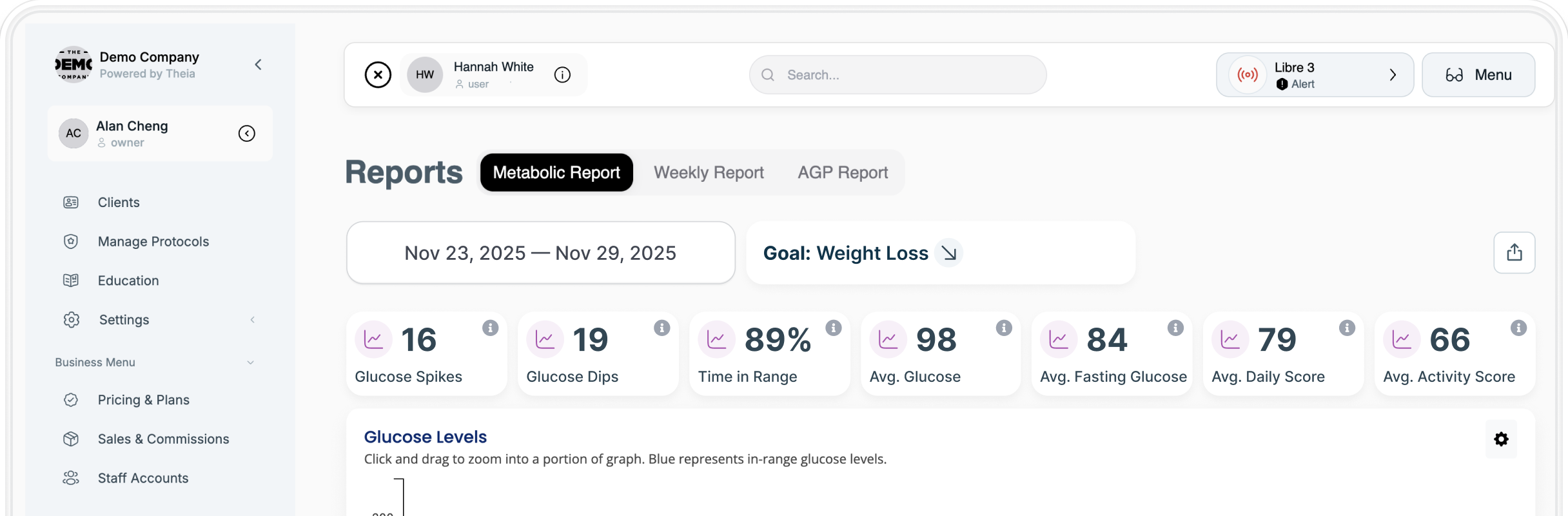
The Ambulatory Glucose Profile (AGP) report standardizes key metrics like Time in Range (TIR), Time Below Range (TBR), and glucose variability, making it easier for providers to interpret CGM data and guide interventions.
In both scenarios, the intervention itself was not new. What changed was the level of clarity. Research tracking non-diabetic participants with CGM found that glucose variability was directly linked to sleep quality and daily activity levels — the kind of pattern that’s only visible with continuous monitoring. This is an approach also used by nutritionists coaching clients on metabolic health — evaluating patterns across sleep, stress, and food timing rather than reacting to individual readings.
How Coaching Changes Once CGM Data Is Introduced
One of the more noticeable shifts in Julia’s model is how the role of the provider evolves once CGM is introduced. Rather than directing behavior, much of the interaction becomes interpretive.
“We’re not sitting there analyzing every number. We’re looking for patterns.”
Providers guide patients through questions:
- What changed between two similar days?
- How did sleep impact your baseline?
- What was different about that meal?
Over time, patients begin to anticipate their own responses.
They recognize patterns before they are pointed out and make adjustments independently. This reduces reliance on external instruction and increases long-term adherence.
“When they see it, they take ownership. That’s when behavior actually changes.”
Operational Considerations with CGM
From a clinical standpoint, integrating CGM was relatively straightforward. The more significant challenge was operational.
As usage increased, so did logistical demands including:
- device onboarding
- troubleshooting
- app support
- replacements
Individually, these issues were manageable. Collectively, they created a steady drain on time and resources. Healthcare practices can develop a CGM workflow that utilizes their team to the top of their licenses, improving efficiency and scalability. At a certain point, it became clear that without additional support, this would limit scalability.
The Role of Theia in Supporting Implementation
To address this, Julia integrated Theia into her workflow. Theia currently supports over 6,300 wellness businesses across 14 provider categories and has processed more than 197 million real-time biodata readings – handling onboarding, device logistics, troubleshooting, and replacements so practitioners can stay focused on clients. See how other providers have built scalable CGM delivery models using the same infrastructure.
By shifting these responsibilities externally, her team was able to maintain focus on patient care rather than technical issues.
“Before, we were managing everything. Now we can actually focus on the patient.”
From a workflow perspective, this changed how CGM fit into the program. It became a scalable layer rather than an operational burden.
For providers considering CGM, this distinction is critical. Without infrastructure, implementation becomes difficult to sustain.
Observed Impact on Patient Engagement and Retention
Two outcomes became clear after CGM was integrated.
The first was on the front end. Patients were more willing to commit to the program. The inclusion of a data-driven component increased perceived value and reduced hesitation.
The second was long-term engagement.
Patients were more likely to:
- stay consistent
- maintain behavior changes
- continue participating over time
The underlying driver appears to be understanding. These patterns have also been observed in fitness programmes targeting women over 50, where seeing glucose responses in real time accelerated behaviour change more effectively than instruction alone. Practices using Theia report an average 15% uplift in care plan conversion after introducing CGM. When patients can consistently see how their body responds, they rely less on motivation and more on their own observations. That tends to hold up over time.
Common Questions About CGM for Providers
How do you introduce CGM without overwhelming patients?
“We don’t start with it. They need a foundation first. Otherwise, it becomes something they react to instead of something they use.”
How do you use CGM data day-to-day?
“We’re not analyzing every number. We’re looking for patterns. Most of the time, they already know—the data just confirms it.”
Has using Theia changed how your model operates?
“Completely. We’re not dealing with logistics anymore. That allows us to focus on what actually matters—working with the patient.”
What does CGM cost, and is it covered by insurance?
Coverage and out-of-pocket costs for CGM may vary based on individual insurance plans. Some commercial insurance plans, Medicare, and Medicaid may cover personal CGM, but eligibility requirements apply. Medicare coverage requires that CGM be used with a reader device, not just a smartphone. Medicaid coverage for personal CGM varies by state—some states offer broad coverage through fee-for-service, while others may not cover it at all. Patients who do not meet their payer’s eligibility criteria for personal CGM may still benefit from professional CGM, which can be useful when personal CGM is not likely to be covered by insurance. Always check with your insurance provider to understand what is covered and what your out-of-pocket costs may be.
The Bottom Line
For Julia, CGM did not replace her model. It strengthened it.
Used appropriately, continuous glucose monitoring shortens the feedback loop between behavior and outcome. It reduces guesswork and allows both providers and patients to identify what is actually driving results.
“The goal isn’t perfect numbers—it’s understanding what’s driving them.”
For providers exploring CGM, the takeaway is clear: the structure around implementation matters as much as the tool itself.
With the right workflow—and the right infrastructure—CGM becomes a scalable way to improve both metabolic and cognitive outcomes.
If you’re a provider looking to integrate CGM into your workflow without adding operational burden, Theia supports onboarding, device logistics, and ongoing patient support. Learn more here by applying to partner.