Introduction
Most of the clients who come to Carrie Lupoli have already tried to “do things right.”
They’ve tracked calories, followed structured plans, and stayed consistent—at least for a period of time. What’s usually missing isn’t effort. It’s clarity. They don’t fully understand why something works when it does, or why it stops working when it inevitably does.
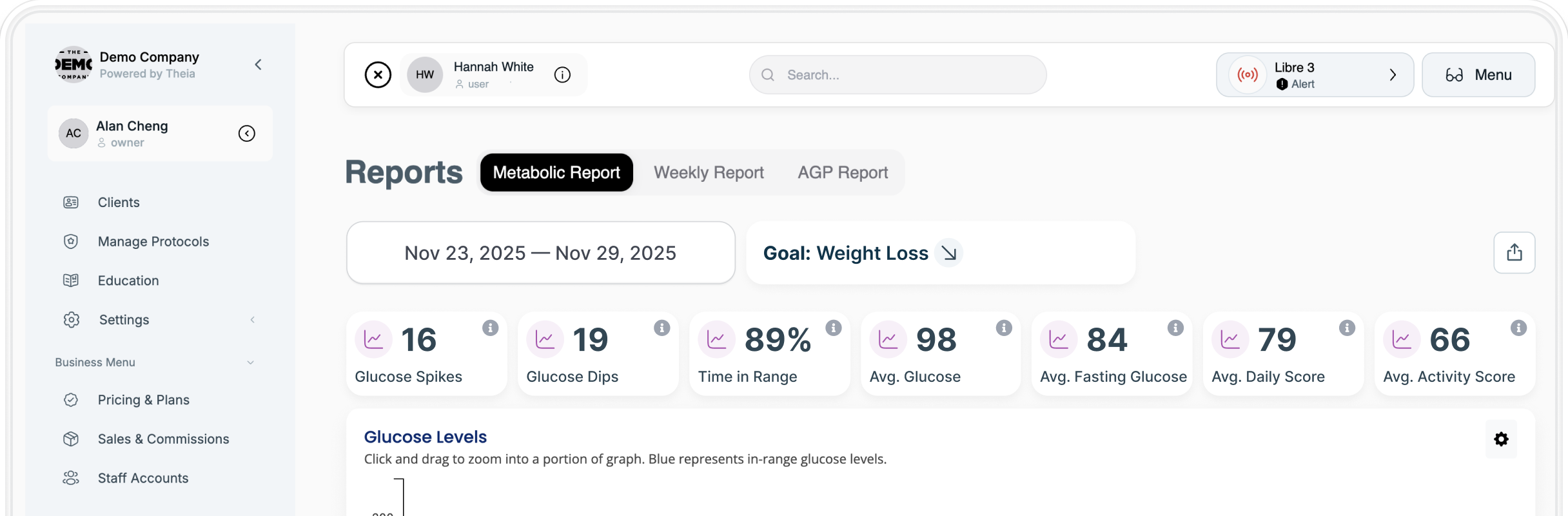
At Disruptive Nutrition, Carrie’s coaching model is built around that gap. Her work focuses on helping clients understand how their body responds to food, stress, and daily habits in a way that feels usable, not theoretical. CGM for metabolic health coaching is a powerful tool that supports overall well-being by providing real-time insights, enabling clients to make informed choices about their health and lifestyle.
Over time, she began integrating continuous glucose monitoring (CGM) via Theia into her programs—not as a primary intervention, but as a way to make those responses visible. The potential benefits of CGM for non diabetic individuals are becoming more recognized, as CGMs are increasingly being used by non-diabetics to track blood glucose for health and wellness purposes.
Key Takeaways
- Carrie stages CGM deliberately – clients spend three to four weeks building foundational habits before a device is introduced, so the data becomes a tool rather than another thing to obsess over
- The goal is pattern recognition over time, not reacting to individual glucose readings – coaches ask questions, clients start connecting the dots themselves
- CGM shortened hesitation at the point of programme enrolment – in a market where many clients have tried multiple approaches, a clear data-driven component reduced skepticism
- Clients who can see how their body responds repeatedly tend to stay more engaged and maintain changes longer — understanding drives adherence better than instruction alone
- Theia handles device onboarding, logistics, and troubleshooting end-to-end, freeing Carrie’s team to focus entirely on coaching rather than tech support. The same operational model has enabled other providers to focus on scaling nutrition delivery across multiple providers without increasing internal burden
Carrie’s Practice Model and Patient Population
Carrie’s practice operates as a high-touch coaching model rather than a clinical service. She works primarily with women between their mid-30s and mid-60s, many of whom are dealing with weight loss resistance, hormonal changes, or some degree of insulin dysregulation. For this population, improving insulin sensitivity and maintaining a healthy weight are key factors in supporting long-term metabolic health.
A consistent pattern across this population is a long history of dieting. Many clients arrive with a tendency toward over-monitoring—tracking food, measuring progress too frequently, and tying outcomes to short-term metrics. Because of that, her model deliberately avoids introducing more tracking at the outset. However, CGMs can help clients improve their eating habits and lifestyle choices by providing real-time insights into how food choices affect blood sugar levels and hunger, supporting more mindful and health-promoting decisions.
Instead, the initial focus is on building repeatable habits around meal structure and blood sugar regulation. Clients are taught to eat consistently, balance macronutrients in a simple way, and pay attention to how they feel throughout the day. That foundation becomes important later, when more data is introduced. Tracking glucose levels with CGMs with Theia can help identify patterns that lead to energy crashes and cravings, and maintaining stable glucose levels may help prevent diabetes and reduce the risk of developing insulin resistance.
What Led Carrie to Explore Theia and CGM?
Before implementing Theia, most of the feedback Carrie relied on came from client-reported symptoms. Energy levels, cravings, hunger, bad sleep and mood provided useful signals, but they weren’t always reliable enough to guide precise adjustments. Research from King’s College London found that glucose variability in non-diabetic individuals is closely linked to diet, lifestyle, and overall health – making real-time monitoring a valuable tool for wellness-focused practitioners.
“Two clients could follow similar recommendations and report very different experiences. One might feel stable and see progress, while another would feel inconsistent despite following the same structure”. says Carrie. From a coaching standpoint, this creates a familiar problem. You’re making adjustments based on patterns, but without being able to see what’s happening in real time, there’s always some degree of uncertainty. CGM readings and the continuous stream of data with Theia allow both coaches and clients to observe glucose patterns throughout the day and night, offering precise insights into glycemic control and glucose variability. This helps identify how lifestyle factors impact blood sugar regulation and supports more targeted interventions.
That uncertainty tends to show up on the client side as well. When progress slows or stalls, clients often assume they’re doing something wrong—even when they’re not.
Watch the Full Conversation with Carrie Lupoli
Check out episode #2 of our Spotlight Series with Carrie Lupoli, where she breaks down how she integrates CGM into her coaching model, improves client adherence, and scales her programs without adding operational complexity.
How Did Carrie Integrate Continuous Glucose Monitoring Into her Program
Carrie’s approach to CGM was intentionally staged.
Clients do not start with a device. In Carrie’s model, clients typically spend three to four weeks building foundational habits – eating at regular intervals, balancing meals, and reducing reliance on external tracking tools before a CGM is introduced. This period allows clients to stabilize somewhat and develop a basic awareness of how their body feels under more consistent conditions.
Only after that baseline is established is CGM introduced. At this stage, CGMs enable blood sugar tracking throughout the day, providing real-time insights into overall patterns and glucose levels as they fluctuate with meals, activity, stress, and sleep. This staged approach is consistent with how other practitioners introduce CGM-including health coaches working at the intersection of metabolic and brain health, where introducing data too early can overwhelm rather than inform.
The reasoning is practical. If a client is already overwhelmed or highly reactive to data, introducing continuous glucose readings too early can create unnecessary noise. By delaying it, the data becomes easier to interpret and less likely to drive impulsive decisions.
Once CGM is in place, it’s framed very clearly. The goal is not to react to every reading, but to observe patterns over time. Clients are encouraged to look at trends rather than individual spikes, and to connect those trends to behaviours they recognize—meals, stress, sleep, and timing. It’s important to note that CGMs measure glucose levels in the fluid surrounding cells, which is similar to blood glucose levels but can be about 9 minutes behind actual blood sugar readings.
To keep the process manageable, detailed food logging is avoided. Instead, clients typically document meals in a lightweight way, often with photos, which provides enough context for both the client and coach to interpret what’s happening.
What Becomes Visible With CGM
The practical value of CGM shows up in how quickly certain patterns become clear.
In one case, a client who believed she was following the program closely continued to see little progress. When her glucose data was reviewed, it showed sustained elevation over a period of nearly two days. There was nothing in her food intake that explained it.
The variable was stress.
While this had been discussed previously, it hadn’t translated into behavior change. Seeing the data made the connection more concrete. It shifted the conversation from something abstract to something measurable. Research tracking non-diabetic participants with CGM found that glucose variability was directly linked to sleep quality and daily activity levels – the kind of pattern that’s only visible with continuous monitoring. Monitoring stress levels and managing stress became a focus, as the CGM data revealed how stress could impact glucose response and contribute to glucose spikes. By addressing stress with practical strategies, clients can optimize their metabolic health and reduce the frequency of stress-induced blood sugar fluctuations.
In another case, a client who relied heavily on convenient, processed “healthy” foods was meeting her macronutrient targets but still experiencing inconsistent results. Her CGM data showed higher variability than expected. After a short trial of shifting toward more whole food sources, her glucose patterns stabilized, and her average levels improved.
CGMs provide insights into how lifestyle factors such as sleep and stress affect glucose levels, helping users optimize their health. They can also help identify insulin resistance in its early stages, allowing for proactive dietary and lifestyle changes.
In both situations, the intervention itself wasn’t new. What changed was the client’s understanding of cause and effect.
How Coaching Changes Once Data Is Available
One of the more noticeable shifts in Carrie’s model is how the role of the coach evolves once CGM is introduced.
Instead of directing behavior, coaches spend more time helping clients interpret what they’re seeing. A large part of the interaction becomes question-based. What changed between two similar meals? What was different about that day? How did sleep or stress factor in? With real-time insights from CGMs, clients can make informed decisions about their food choices and daily habits, feel empowered to take control of their health, and implement meaningful lifestyle changes.
Over time, clients begin to anticipate their own responses. They recognize patterns before they’re pointed out, and they adjust accordingly. CGMs provide real-time feedback on how different foods affect glucose levels, allowing users to make informed dietary choices and targeted lifestyle changes to stabilize blood sugar and reduce the risk of progression to diabetes.
There are still situations where direct guidance is necessary, particularly when patterns are clear but behavior hasn’t changed. But in general, the goal is to reduce dependency on instruction and increase independent decision-making.
That shift is what supports longer-term adherence.
Operational Considerations
From a clinical perspective, integrating CGM was relatively straightforward. The more significant challenge was operational.
As usage increased, so did the number of small logistical issues—device setup, sensor failures, app questions, replacements. None of these were complex individually, but together they created a steady demand on the team’s time.
At a certain point, it became clear that without additional support, this would limit the ability to scale.
Role of Theia in Supporting Implementation
To address this, Carrie integrated Theia into her workflow to manage the non-clinical aspects of CGM. Theia currently supports over 6,300 wellness businesses across 14 provider categories and has processed more than 197 million real-time biodata readings – handling onboarding, device logistics, troubleshooting, and replacements so practitioners can stay focused on their clients.
This included onboarding support, device logistics, troubleshooting, and replacements. By shifting those responsibilities externally, her team was able to maintain focus on coaching rather than technical issues.
From a workflow standpoint, this changed how CGM fit into the practice. Instead of being something that required ongoing management, it became a layer that could be added without significantly increasing operational load.
Observed Impact on Engagement and Retention
Two outcomes became apparent after CGM was integrated.
The first was on the front end. Clients were quicker to commit to the program. In a market where many have tried multiple approaches, having a clear, data-driven component reduced hesitation. Practices using Theia report an average 15% uplift in care plan conversion after introducing CGM. The use of CGM in coaching leads to better health outcomes and can help extend health span by empowering individuals to make informed choices that support longevity and quality of life.
The second was longer-term retention. Clients were more likely to stay engaged and maintain changes over time. Participants using CGM with personalized nutrition advice experience greater weight loss and fat mass reduction compared to those following standard dietary recommendations.
The underlying reason appears to be understanding. When clients can repeatedly see how their body responds, they rely less on external motivation and more on their own observations.
That tends to hold up better over time.
Common Questions About Theia for Nutritionists
How do you introduce continuous glucose monitoring without overwhelming clients?
“I don’t start with it. That’s really important. We wait a few weeks before putting a CGM on someone. They need to understand how to eat, how to think differently about their body, and start feeling some level of stability first. Otherwise, the CGM just becomes another thing to obsess over—like the scale or calorie tracking. By the time we introduce it, they’re ready to use it as a tool, not something they react to.”
How do you actually use CGM data with clients day-to-day?
“We’re not sitting there analyzing every number. That’s not the goal. We’re looking for patterns. I’ll ask them questions—‘Why do you think that happened?’—because most of the time, they already know. The data just confirms it. Sometimes we’ll need to be more direct, but ideally, they start connecting the dots themselves. That’s where the real change happens.”
Has using Theia changed how your practice operates?
“Completely. Before, we were basically becoming a tech support company on top of being coaches. There were too many moving pieces—devices, troubleshooting, replacements. It was taking time away from actual coaching. With Theia, my team doesn’t have to deal with that anymore. They handle it, and we can just focus on our clients. That’s made a huge difference in how we scale.”
The Bottom Line: Carrie’s Theia’s Integration
For Carrie, CGM didn’t replace her coaching or foundational nutrition principles. It supported her expert guidance. CGMs provide real-time tracking of blood sugar levels, allowing users to make informed health choices and work toward optimal health.
Used appropriately, it shortens the feedback loop between behavior and outcome. It reduces guesswork, both for the provider and the client, and makes it easier to identify what is actually driving results. CGMs can be used to monitor glucose levels continuously, providing a more comprehensive view of metabolic function compared to traditional finger-prick tests.
For providers considering implementation, the structure around CGM matters as much as the tool itself—when it’s introduced, how it’s framed, and how much operational support is in place.
Theia works with coaching and care teams to support that implementation—from device logistics to ongoing support—so providers can stay focused on clinical outcomes and client engagement.
If you’re exploring how this could fit into your practice, you can learn more by clicking here and applying to partner with us.